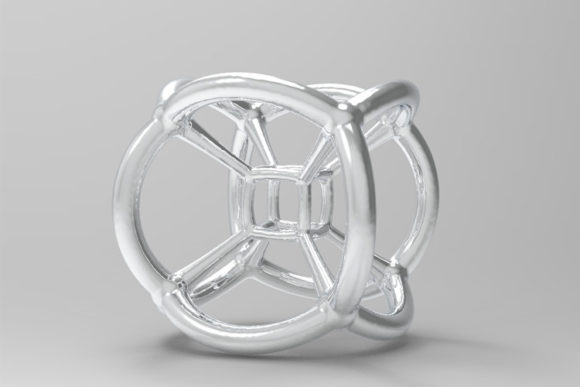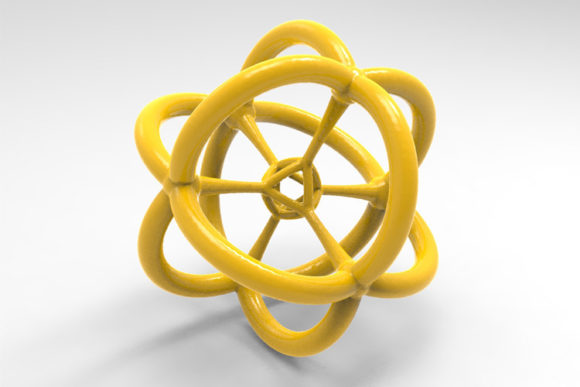
4D Polytope Bead Model for 3D Printing
At first glance, the 4D Polytope Bead Model might seem like an abstract concept reserved for mathematicians and theoretical physicists. Yet, in the world of 3D printing and wearable art, this geometric marvel has found a surprisingly accessible and beautiful application. The model translates complex four-dimensional geometry into a tangible, printable form—perfect for jewelry, educational tools, or artistic expression. Whether you're a designer, educator, or hobbyist, this bead model offers a unique intersection of math, design, and creativity.
What Is a 4D Polytope Bead Model?
A 4D polytope is the four-dimensional analog of a three-dimensional polyhedron or a two-dimensional polygon. While we can't physically experience four-dimensional space, we can project these shapes into lower dimensions. The bead model simplifies this projection into a 3D-printable format, often resembling a symmetrical, interlocking lattice that captures the essence of higher-dimensional geometry.
Designed with precision, the model is scaled in millimeters to ensure print accuracy and wearability. This makes it ideal for crafting pendants, earrings, or other small accessories that carry a sense of intellectual elegance and modern minimalism.
Creative Possibilities in Design
One of the most exciting aspects of the 4D Polytope Bead Model is its versatility in design. Its geometric structure can be interpreted in multiple ways, offering room for creative experimentation:
- Minimalist Jewelry: Use the bead model as a centerpiece in a simple silver or gold chain for a clean, intellectual aesthetic.
- Layered Necklaces: Combine the polytope bead with other geometric pendants for a layered look that hints at mathematical curiosity.
- Customized Color: Print the model in a variety of materials and colors to match different fashion styles or moods.
- Math-Themed Gifts: Offer the bead as a unique gift for educators, students, or professionals in STEM fields.
Designers can also modify the original model to suit different aesthetics—adding textures, integrating patterns, or combining it with other shapes for a more personalized feel.
Applications Beyond Jewelry
While the bead model shines as a wearable object, its applications extend into other creative and educational domains:
- STEM Education: Use the model as a visual aid to teach spatial reasoning, geometry, or the concept of dimensions beyond three.
- Exhibition Pieces: Incorporate the bead into art installations that explore the intersection of science and design.
- Decorative Accents: Print larger versions to use as hanging ornaments or wall decor in science-themed spaces.
- Interactive Learning Kits: Bundle the model with explanatory materials for classrooms or maker workshops.
For educators and content creators, the bead model becomes a conversation starter—bridging abstract mathematics with real-world creativity.
Adapting the Model for Different Audiences
One of the strengths of the 4D Polytope Bead Model is its ability to be tailored to various audiences and platforms. Here’s how different users can apply it:
- Designers: Focus on aesthetics and wearability. Experiment with different finishes and materials to match current fashion trends.
- Entrepreneurs: Market the bead as a niche product for science enthusiasts or as part of a curated collection of mathematical jewelry.
- Bloggers & Influencers: Feature the model in posts about wearable tech, mathematical art, or 3D printing trends.
- Hobbyists: Use it as a weekend project to explore 3D modeling and printing techniques while creating something meaningful.
- Educators: Integrate the bead into lessons on geometry, topology, or digital fabrication.
By adjusting the presentation, scale, and context, the same model can serve vastly different purposes—from a classroom tool to a fashion statement.
Practical Tips for 3D Printing Success
To ensure the best results when printing the 4D Polytope Bead Model, consider the following:
- Material Choice: Use high-detail resin or fine nylon for intricate features. For durability, consider PLA or PETG for larger versions.
- Print Settings: Opt for a layer height of 0.1mm or less to capture the fine geometry accurately.
- Orientation: Position the model so that overhangs are minimized or supported to maintain structural integrity.
- Post-Processing: Sanding and polishing can enhance the bead’s smoothness and visual clarity.
- Sizing: Check the provided millimeter measurements to ensure compatibility with your intended use, especially for jewelry settings.
Testing with a small-scale print before committing to a final version can save time and material, especially when experimenting with new finishes or styles.
Inspiration Through Interpretation
Don’t feel limited by the original design. The 4D Polytope Bead Model is a foundation—a starting point for your own creative exploration. Consider these variations:
- Fractal Variants: Repeat the polytope structure at different scales to create a fractal-inspired bead.
- Modular Assemblies: Print multiple beads and link them together for a dynamic necklace or bracelet.
- Hybrid Designs: Merge the bead with other geometric forms or natural motifs to create a fusion of styles.
- Illuminated Versions: Hollow out the bead and insert an LED for a glowing wearable sculpture.
Each variation opens up new possibilities for storytelling, personalization, and functional design.
Sharing the Beauty of Higher Dimensions
Ultimately, the 4D Polytope Bead Model bridges the gap between abstract mathematics and everyday creativity. It invites wearers and viewers alike to engage with the beauty of multidimensional geometry in a way that's accessible and visually compelling. Whether you're crafting for personal satisfaction, commercial appeal, or educational impact, this model offers a unique opportunity to bring complex ideas into physical form.
As 3D printing continues to evolve, so too will our ability to explore and express mathematical beauty through tangible objects. The 4D Polytope Bead Model stands as a testament to what’s possible when creativity meets precision—and a reminder that inspiration can come from the most unexpected corners of science.